
Choosing the right espresso machine starts with understanding how different machines work. Some give you complete control over brewing, while others grind coffee beans and prepare drinks automatically. Commercial machines are designed for busy cafés, offices, and restaurants, while portable options are ideal for travel.
The best espresso machine depends on where you plan to use it, how often you make coffee, and how much control you want over the brewing process.
In this guide, we explain seven main espresso machine types, compare their features, and help you choose the right option for your home, office, café, or business.
7 Espresso Machine Types Explained
What Are the Main Types of Espresso Machines?
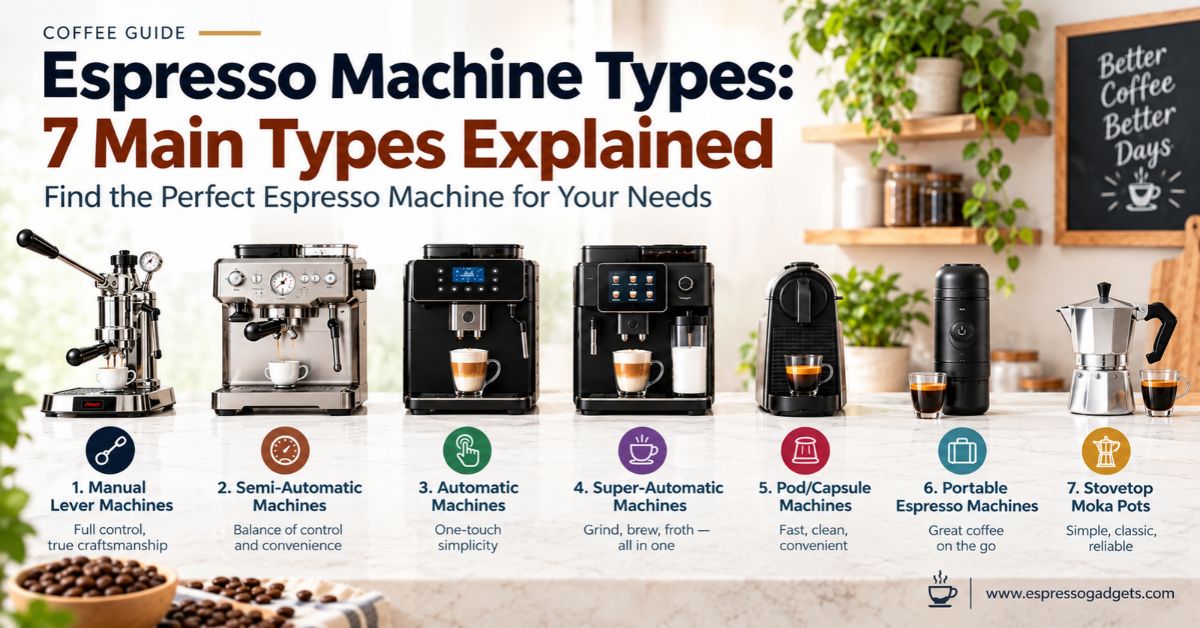
Espresso machines come in different designs based on how they operate, their level of automation, and their intended use. The main types include manual lever, semi-automatic, automatic, super-automatic, capsule, commercial, and portable espresso machines.
These categories are not all mutually exclusive. For example, a commercial espresso machine can also be semi-automatic, while some portable machines use manual brewing mechanisms.
Here is a quick overview of the seven main types.
| Espresso machine type | Main feature | Best for |
|---|---|---|
| Manual lever | User controls the brewing pressure | Coffee enthusiasts |
| Semi-automatic | User controls key brewing steps | Home baristas |
| Automatic | Stops extraction at a programmed volume | Users who want repeatable shots |
| Super-automatic | Automates grinding and brewing | Homes and offices |
| Capsule | Uses pre-portioned coffee capsules | Beginners and convenience seekers |
| Commercial | Designed for frequent, high-volume service | Cafés and restaurants |
| Portable | Compact design for travel | Travelers and campers |
Let’s look at each type in detail.
1. Manual Lever Espresso Machines
Manual lever espresso machines give users direct control over the brewing process. Instead of relying entirely on an electric pump, these machines use a lever to generate or regulate pressure, depending on the design.
You usually need to grind the beans, measure the coffee, prepare the coffee puck, and manage the extraction yourself. This makes manual machines appealing to people who enjoy learning traditional barista techniques.
Key features
- Manual control over brewing pressure on many models
- Hands-on coffee preparation
- No automatic grinding or brewing workflow
- Some models operate without electricity
- A learning curve for beginners
Pros and cons
Pros
- Greater control over extraction on suitable models
- Engaging experience for coffee enthusiasts
- Some models have simple mechanical designs
- Can produce excellent espresso with the right technique
Cons
- Requires practice and attention
- Usually needs a separate grinder
- Can take longer to prepare each drink
- Milk steaming may require separate equipment
Who should choose a manual lever machine?
Choose a manual lever machine if you enjoy experimenting with coffee and want to control the brewing process. It is a good fit for enthusiasts who value technique over speed.
For busy households, offices, or cafés, a more automated machine may be easier to manage.
2. Semi-Automatic Espresso Machines
Semi-automatic espresso machines are popular among home baristas because they balance control and convenience.
An electric pump generates brewing pressure, but you remain responsible for tasks such as grinding, dosing, tamping, and usually starting and stopping the shot. This allows you to experiment with coffee beans and extraction settings.
Some models include a built-in grinder, while others require a separate one.
Key features
- Electric pump-assisted brewing
- Manual control over shot extraction on typical models
- Flexibility to adjust coffee dose and grind size
- Steam wand on many models
- Options for beginners and experienced users
Pros and cons
Pros
- Offers a balance of control and convenience
- Helps you develop barista skills
- Suitable for espresso, cappuccino, and latte preparation
- Allows experimentation with different coffee beans
Cons
- Requires practice for consistent results
- May need a separate grinder and accessories
- Needs regular cleaning
- Results depend on preparation and technique
Who should choose a semi-automatic machine?
A semi-automatic machine is a strong choice for people who want to learn to make espresso at home. It is especially suitable if you enjoy adjusting your coffee and preparing milk-based drinks.
If you’re comparing models for everyday use, explore our guide to the best espresso machines for home.
3. Automatic Espresso Machines
Automatic espresso machines simplify one part of the brewing process: controlling how much coffee is dispensed.
Traditional automatic machines can stop extraction when they reach a programmed water volume. However, you generally still need to prepare the coffee grounds and manage the portafilter.
This differs from super-automatic machines, which automate much more of the preparation process.
Key features
- Programmed or volumetric shot control on many models
- Electric pump-assisted brewing
- Portafilter-based preparation
- Repeatable programmed shot portions
- Manual preparation on most traditional models
Pros and cons
Pros
- Reduces the need to stop shots manually
- Helps produce repeatable shot volumes
- Retains hands-on control over coffee preparation
- Useful when preparing several drinks
Cons
- Still requires grinding and tamping on most models
- Programmed volume does not guarantee perfect extraction
- Features vary between machines
- Can cost more than a basic semi-automatic model
Who should choose an automatic machine?
Choose an automatic espresso machine if you want more consistent shot portions while retaining control over coffee preparation.
It can suit experienced home users and smaller coffee operations that want a more repeatable workflow without fully automating the entire process.
4. Super-Automatic Espresso Machines
Super-automatic espresso machines, also called bean-to-cup machines, automate most of the brewing process.
Many models grind whole beans, dose them, prepare the coffee internally, and brew espresso with minimal effort. Depending on the model, they may also prepare milk foam for cappuccinos and lattes.
You typically select a drink using buttons or a touchscreen.
Key features
- Built-in coffee grinder
- Automated grinding and brewing
- One-touch espresso on many models
- Programmable drink settings on selected models
- Automatic or assisted milk preparation on some machines
Pros and cons
Pros
- Convenient for everyday coffee preparation
- Requires fewer barista skills
- Often supports multiple drink styles
- Suitable for households and shared office kitchens
Cons
- More complex internal mechanisms
- Requires routine cleaning and maintenance
- Usually offers less direct control than traditional machines
- Milk systems can require additional cleaning
Who should choose a super-automatic machine?
Super-automatic machines are ideal for people who want fresh-ground coffee without managing every brewing step.
They work well in homes, offices, and other settings where convenience matters. For workplaces with frequent coffee use, choose a model with appropriate capacity, easy maintenance, and a brewing system designed for the expected demand.
5. Capsule Espresso Machines
Capsule espresso machines use pre-portioned coffee sealed in compatible pods or capsules. You insert a capsule, start the machine, and let it prepare the drink.
These machines reduce the need to grind, dose, and tamp. They also create less loose-coffee mess than traditional portafilter machines.
However, capsule systems differ in their brewing methods and the drinks they produce. Not every pod-based coffee maker makes espresso in the same way as a traditional pump-driven machine.
Key features
- Pre-portioned coffee capsules
- Simple operation
- Quick preparation
- Minimal loose coffee grounds
- Compatibility limited by the capsule system
Pros and cons
Pros
- Beginner-friendly
- Convenient for quick drinks
- Requires little preparation
- Offers consistent portions with compatible capsules
Cons
- Ongoing capsule costs
- Less control over coffee preparation
- Limited flexibility compared with fresh whole beans
- Recycling options vary by capsule system
Who should choose a capsule machine?
A capsule machine is a good choice for beginners, occasional coffee drinkers, and people who prioritize convenience.
It can also work in an office where employees want quick coffee without learning espresso-making techniques. Before buying, check capsule availability and the long-term cost of your preferred system.
6. Commercial Espresso Machines
Commercial espresso machines are designed for businesses that prepare coffee regularly and may need to serve many customers in a short period.
They are commonly found in cafés, coffee shops, restaurants, hotels, and catering operations. Depending on the design, a commercial machine may have one or multiple group heads, a professional steam system, and controls intended for repeated use.
Commercial machines are available in semi-automatic, automatic, and other configurations. Therefore, commercial refers to the intended application rather than a specific brewing mechanism.
Key features
- Designed for frequent use
- One or more group heads on many models
- Professional milk-steaming capabilities
- Larger water capacity or plumbed water connections on some models
- Controls and workflow suited to food-service environments
Pros and cons
Pros
- Suitable for busy coffee-service environments
- Can support multiple drinks and users
- Often provides professional milk-steaming performance
- Some configurations improve workflow during peak periods
Cons
- Usually more expensive than home machines
- Requires more counter space
- May need professional installation
- Can require specialized maintenance and servicing
Who should choose a commercial machine?
Choose a commercial espresso machine if you operate a café, restaurant, hotel, or coffee-serving business.
Before purchasing, estimate how many drinks you expect to prepare during peak periods. Also consider electrical requirements, water connections, grinder quality, service availability, and the machine’s cleaning needs.
For a small business or shared office, a commercial machine may be unnecessary if the expected coffee demand is low.
You May Like > 7 Best Commercial Espresso Machines: Top Picks
7. Portable Espresso Machines
Portable espresso machines are designed for people who want concentrated coffee while traveling or spending time outdoors.
Some models use manual pumping, while others use batteries or electricity. Certain devices heat water themselves, whereas others require you to add hot water.
Portable machines are generally smaller than countertop espresso machines, but their brewing performance, pressure systems, and convenience vary by model.
Key features
- Compact, travel-friendly design
- Manual, battery-powered, or electric operation
- Small water and coffee capacity
- Some models work without mains electricity
- Limited or no milk-steaming capability
Pros and cons
Pros
- Convenient for road trips and camping
- Takes up little space
- Some models work without mains power
- Useful when a full-size machine is impractical
Cons
- Limited drink capacity
- Some models require a separate hot-water source
- Manual operation can take effort
- Usually unsuitable for preparing many drinks quickly
Who should choose a portable machine?
Portable espresso machines are ideal for travelers, campers, and people who want coffee away from home.
They can also serve as a secondary coffee-making device. However, if you regularly prepare cappuccinos or lattes for several people, a full-size machine is generally more practical.
Espresso Machine Types by Where You Use Them
The seven categories above explain how machines work or what they are designed to do. You can also classify espresso machines by their intended environment.
Espresso machines for home
Home espresso machines are designed for personal use. They range from entry-level semi-automatic models to advanced machines with built-in grinders and automatic milk systems.
The best option depends on your coffee habits, available space, and willingness to learn. A semi-automatic machine is suitable for hands-on users, while a super-automatic machine is convenient for people who want coffee at the touch of a button.
Espresso machines for offices
Office espresso machines need to be convenient for multiple users. Simple controls, reliable operation, easy cleaning, and suitable brewing capacity are especially important.
A super-automatic machine can be a practical choice for many offices because employees can prepare drinks without learning barista techniques. Larger workplaces may need a higher-capacity commercial setup.
Espresso machines for cafés and coffee shops
Cafés generally need machines that can handle repeated drink preparation, milk steaming, and busy service periods.
Commercial machines with suitable group-head capacity and steam performance are often the better fit. The final choice should depend on expected drink volume, menu requirements, available space, and maintenance support.
Espresso machines for restaurants and hotels
Restaurants and hotels may need different machine configurations depending on how they serve coffee.
A breakfast buffet may benefit from a convenient automatic system, while a restaurant with a dedicated coffee bar may need a professional machine that can prepare espresso-based drinks throughout service.
Espresso machines for travel
Travel-focused machines prioritize compact size and portability. They are useful for camping, road trips, and locations without a conventional coffee setup.
Check whether the machine heats water, needs batteries, or requires manual pumping before choosing one for your trips.
How to Choose the Right Espresso Machine
Once you understand the different types, consider these factors before purchasing a specific model.
1. Decide where you will use it
Start with your main use case. A home kitchen, shared office, busy café, and campsite have different needs.
Home users may prioritize drink quality and counter space. Offices may need simple operation, while cafés need equipment that can handle regular service.
2. Set your budget
Consider the total cost, not just the machine price.
A semi-automatic machine may require a separate grinder and accessories. Capsule machines have recurring capsule costs. Commercial equipment may involve installation, water filtration, and professional servicing.
3. Choose your preferred level of control
If you want to experiment with extraction, consider a manual or semi-automatic machine.
If you prefer programmed shots, an automatic model may suit you. If you want the machine to handle grinding and brewing, consider a super-automatic option.
4. Check milk preparation features
If you enjoy cappuccinos and lattes, look for a suitable steam wand or automatic milk system.
Manual steam wands give you more control over milk texture but require practice. Automatic systems can simplify preparation, although their results and cleaning requirements vary.
For more options, read our guide to the best cappuccino machines for home.
5. Consider capacity and speed
Capacity matters more when several people use the machine or when customers need drinks during busy periods.
A small home machine may work well for a few drinks each day, but a busy café usually needs equipment designed for more frequent use. Consider peak demand, recovery time between tasks, and how many drinks you expect to serve.
6. Review cleaning and maintenance
Every espresso machine requires routine care.
Traditional machines need their portafilters and brewing areas cleaned, and steam wands must be cleaned after milk use. Super-automatic machines may require internal cleaning cycles. Capsule machines still need descaling and regular maintenance.
For business use, also check local servicing options and replacement part availability.
Frequently Asked Questions
What are the seven main types of espresso machines?
Seven useful categories are manual lever, semi-automatic, automatic, super-automatic, capsule, commercial, and portable espresso machines. They describe different operating methods and intended applications, so some categories can overlap.
Which type of espresso machine is best for home use?
A semi-automatic machine is a good choice if you want to learn espresso preparation and control your drinks. A super-automatic machine is better if you prefer a convenient, mostly hands-off experience.
Which espresso machine is best for an office?
A super-automatic machine is often a practical option for an office because it simplifies preparation for multiple users. Larger workplaces may need a higher-capacity machine based on daily demand.
Which espresso machine is best for a café?
A commercial espresso machine is generally the most appropriate choice for a café. The required configuration depends on expected drink volume, menu, staffing, available space, and budget.
What is the difference between automatic and super-automatic espresso machines?
A traditional automatic machine can stop a shot at a programmed volume, but users usually prepare the coffee themselves. A super-automatic machine typically automates grinding, dosing, and brewing, with some models also preparing milk drinks.
Are capsule espresso machines worth buying?
Capsule machines can be worthwhile if you prioritize speed, simplicity, and minimal preparation. However, compare capsule prices, compatibility, and recycling options before committing to a particular system.
Are portable espresso machines as good as regular espresso machines?
Some portable machines can produce satisfying concentrated coffee, but performance varies by model. They are designed for portability and are generally less convenient for preparing multiple drinks or steaming milk.
Can a commercial espresso machine be semi-automatic?
Yes. Commercial machines can be semi-automatic or automatic. The term commercial describes the machine’s intended use, while semi-automatic describes how the brewing process is controlled.
Final Verdict
No single espresso machine type works best for everyone. The right choice depends on how much control you want, where you will use the machine, and how many drinks you need to prepare.
Manual lever machines suit enthusiasts who enjoy hands-on brewing, while semi-automatic machines offer a useful balance of control and convenience. Automatic and super-automatic models simplify different parts of coffee preparation, capsule machines prioritize speed, commercial machines serve business needs, and portable devices make coffee possible while traveling.
Start by identifying your main use case, then compare capacity, grinder requirements, milk features, maintenance, and overall cost.
If you’re shopping for a home setup, explore our guide to best espresso machines for home to compare models for different budgets and coffee preferences.